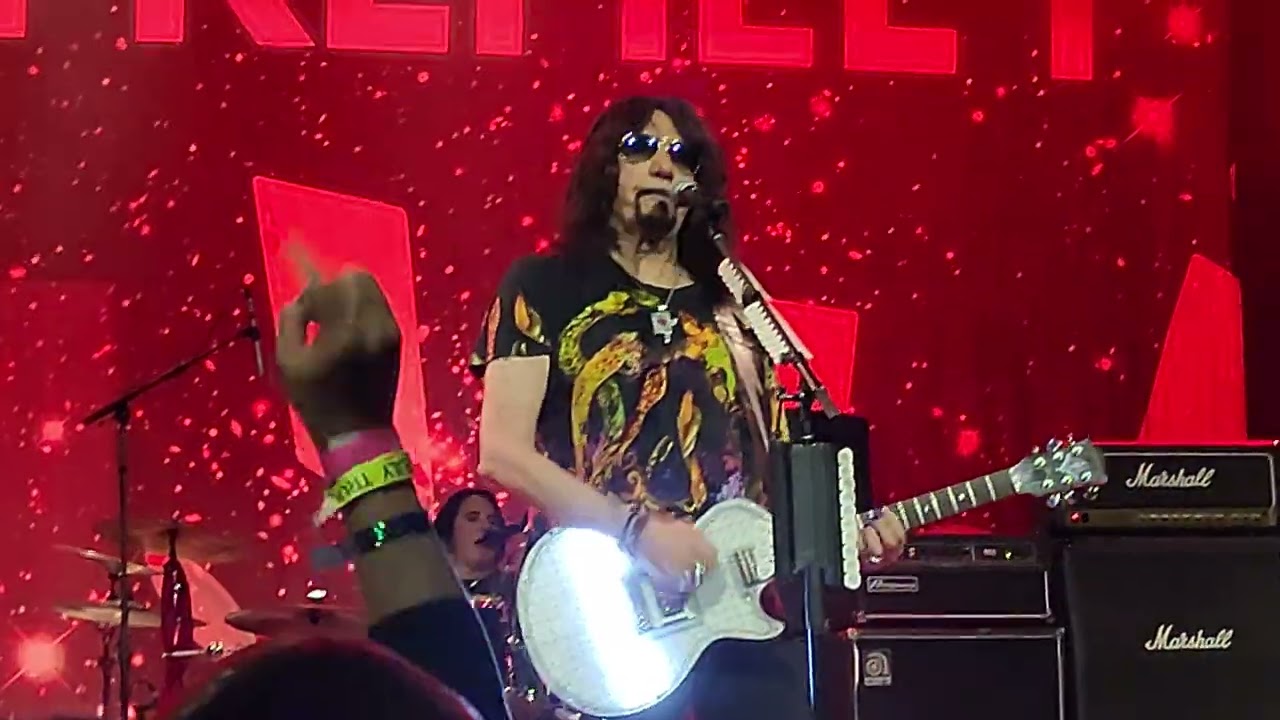
Original KISS lead guitarist Ace Frehley, who recently passed away had previously revealed that producer Bob Ezrin composed one of the group’s most recognizable and classic guitar solos, further explaining how Ezrin helped shape what is largely considered one of their best-ever studio albums.
For some rock acts in the 70s who scored a surprise massive hit with a live album, issuing a follow-up studio effort and enjoying continued success on that level proved to be dicey. For example, Peter Frampton’s “Frampton Comes Alive” (1976) and Cheap Trick’s “At Budokan” (1979) immediately come to mind.
But this proved not to be the case with KISS, who followed up their breakthrough 1975 double-LP, “Alive!”, with a heavily-produced studio effort, 1976’s “Destroyer,” which helped set the quartet up for further chart success for the remainder of the decade. Thanks in large part to Ezrin’s vision.
Ace Frehley talks about Bob Ezrin
“Well, Bob brought a cohesiveness and a sound that we didn’t have before we hooked up with Bob,” Ace Frehley said in an interview with Banger TV, filmed in 2010. “Bob [is] classically trained, and had made a lot of hit records prior to working with us.”
“So, he had a proven formula, and we had to kind of fit into his formula. I think it worked on a lot of the songs. I thought ‘Destroyer’ was a great record.”
Having previously worked with Alice Cooper on such classic albums as 1971’s “Love It to Death” and “Killer”, 1972’s “School’s Out”, 1974’s “Billion Dollar Babies”, and 1975’s “Welcome to My Nightmare”, Ezrin tried to convince KISS to try a different approach on the follow-up to “Alive!”
“I encouraged the band to draw deeper than just the sex and rock and roll themes”, Ezrin told Rock Cellar Magazine in 2022. “That was the point [at] the meeting, we had to put some flesh on these characters. We had to give them a little bit more humanity. And while the original idea was that they were going to be kind of cartoon superheroes and not themselves, I said, ‘We have to put some of the real you back into this thing’.”
“They were excited by that challenge. Nobody had really ever spoken about in that way before, and I think that the minute we started to talk about it, it resonated with them. They got it right away.”
The song that perfectly exemplified this new approach was the album opening “Detroit Rock City,” which starts and ends with sound effects painting a picture of a rock fan getting ready to drive to a rock concert (supposedly Kiss), and by the song’s conclusion, ends up meeting his maker. This was in sharp contrast to the overtly sexual lyrics in such earlier songs as “Nothin’ to Lose” and “Room Service.”